

Ancient Olive Tree in Crete Is Still Producing Fruit After 2,000 Years
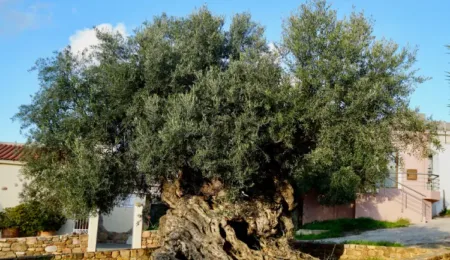
In the Cretan village of Ano Vouves stands a monumental olive tree that locals call Elia Vouvon, the Olive Tree of Vouves. This twisted, ancient tree is believed to be anywhere from 2,000 to 4,000 years old and astonishingly still produces olives each year.
Burial sites, discovered close to the tree, suggest that it may have already been mature when those graves were dug between 900 and 700 BCE.
The Olive Tree of Vouves is located on the island of Crete, in Ano Vouves, standing on a limestone terrace just west of the village center.
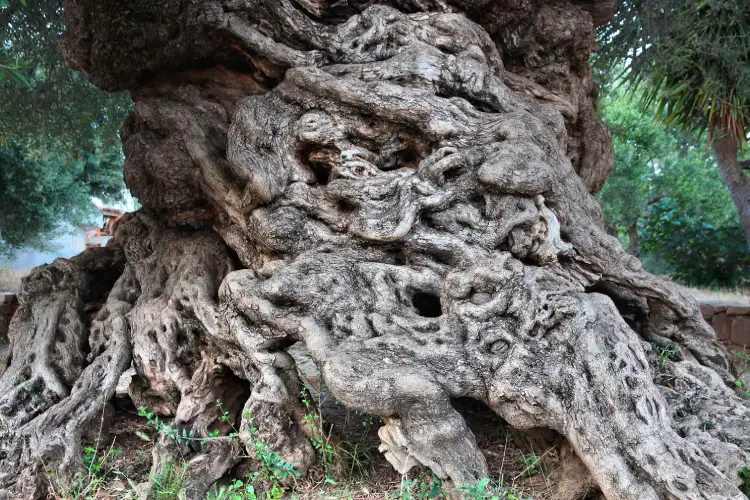
The tree has a massive, twisted trunk, approximately 12.5 meters in circumference (about 4.6 meters in diameter), shaped by millennia of growth. The bark and burls create a sculptural appearance, reminiscent of Renaissance carvings.
Inside that gnarled base, however, the oldest inner wood has long rotted away.
Surprisingly, the tree continues to produce olives every year. It has even been grafted onto a common Cretan cultivar (‘Tsounati”) to ensure productivity.
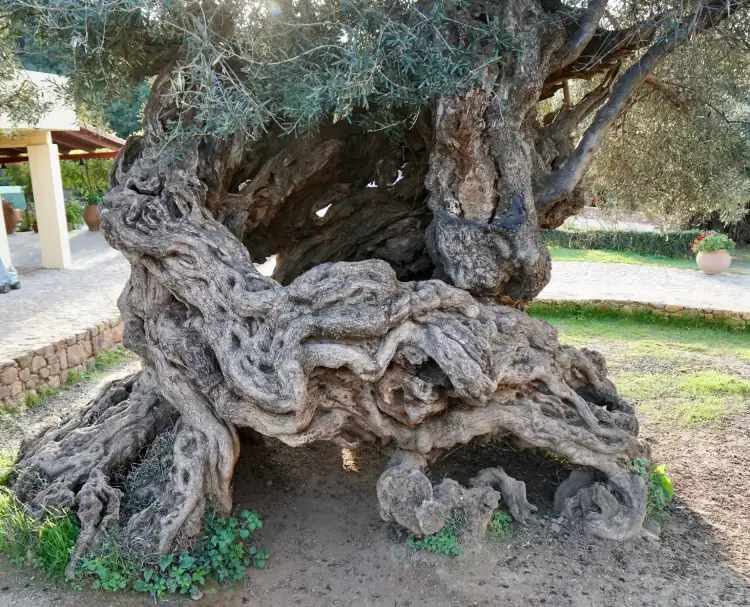
Estimating the age of the Vouves tree is challenging. The inner trunk has rotted away over time, making techniques such as counting growth rings or using radiocarbon dating impossible.
Archaeologists have discovered two ancient burial grounds from the Geometric period (roughly 900–700 BCE) not far from the tree. Their presence suggests the tree may have already been old by that time.
Based on tree-ring fragments and local lore, scientists set only a broad range for the tree’s age. Researchers from the University of Crete once estimated its age to be around 4,000 years, although others suggest it is at least 2,000 years old.
It is safe to say the tree has lived through the Classical Greek and Roman eras, persisting into the modern day.
The tree was officially declared a preserved natural monument in 1997 by the Cretan government.
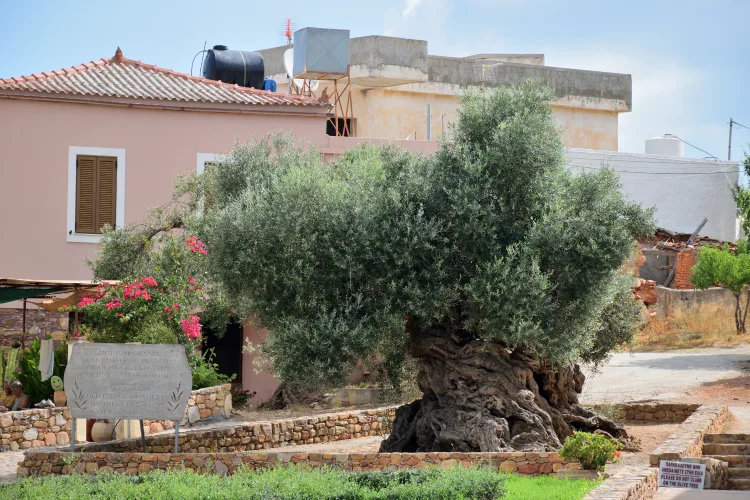
Although its exact age remains unknown, the Olive Tree of Vouves is widely valued for its environmental and cultural significance. In 1997, it was granted protected status by Cretan officials as a natural monument. It is frequently mentioned among the oldest surviving olive trees in recorded history.
In modern times, it has even played a role in Greek tradition: branches from this very tree were used to make the olive wreath crowns awarded to Olympic victors at the Athens 2004 and Beijing 2008 Games.
It remains a well-known site in the region, and the Olive Tree Museum of Vouves, situated in a restored 19th-century structure nearby, provides visitors with insights into the history of olive cultivation.
Opened in 2009, the museum exhibits traditional olive press tools, ancient pottery, and provides explanations of olive oil production in Crete. Just beside the tree, the museum’s backyard terrace provides a view of the ancient trunk.
Today, the tree continues to grow, offering a connection between ancient times and the present. Its story is celebrated in local media and travel writing as a quiet witness to history. Visitors to Ano Vouves can see this gnarled trunk up close and learn about the olive’s central place in Greek culture.
The adjacent museum offers further context, tracing the cycle of olive harvesting and oil production from ancient times through the mid-20th century.