10 People Who Lived in an Airport for Months 5.9k views
For centuries, the Kitayama area of Kyoto, Japan, has been known for producing highly specialized cedar timber. One traditional method used in the region is “daisugi,” in which foresters carefully prune a cedar so that several straight stems grow from a single stump. These stems can then be harvested individually while the underlying stump remains in place.
The method creates the unusual appearance of a large cedar base supporting a group of tall, straight trunks. Although daisugi is no longer widely used as a commercial forestry system, it remains an important part of the history and traditional forestry practices of Kitayama.
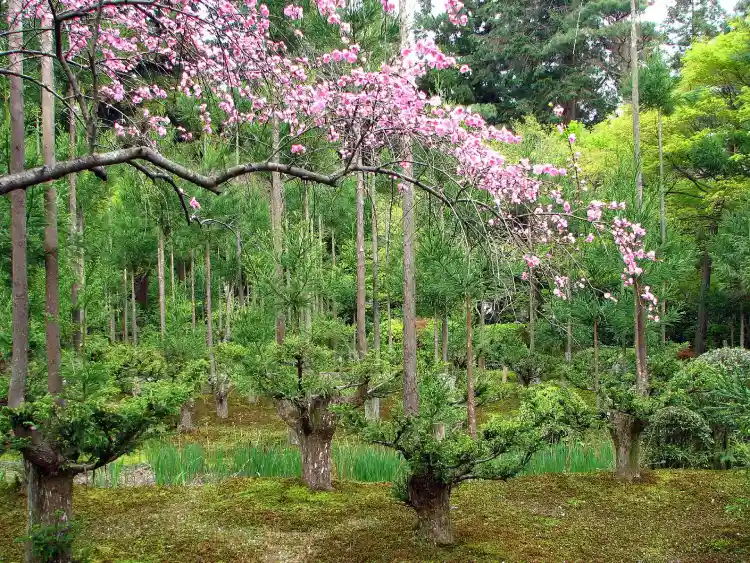
Kitayama forestry is centered around the Nakagawa area of northern Kyoto. Kyoto City says the production of Kitayama timber is believed to date back about 600 years, with some accounts placing its origins before the Edo period. The area became known for producing polished cedar logs with a distinctive smooth and glossy surface.
The local geography also influenced the development of the forestry system. Kyoto City’s official material explains that the area had limited agricultural land and difficult terrain, while seedlings were valuable. Daisugi made it possible to grow multiple stems from a single seedling, allowing foresters to use narrow, steep land.
Kitayama cedar also became important for traditional Japanese architecture. Its polished logs were used as decorative building materials, including pillars and other elements of traditional residences. Kyoto City notes that Kitayama timber was used in buildings, including the Katsura Imperial Villa, the Shugakuin Imperial Villa, Daitokuji, and Kinkakuji, as well as in private homes.
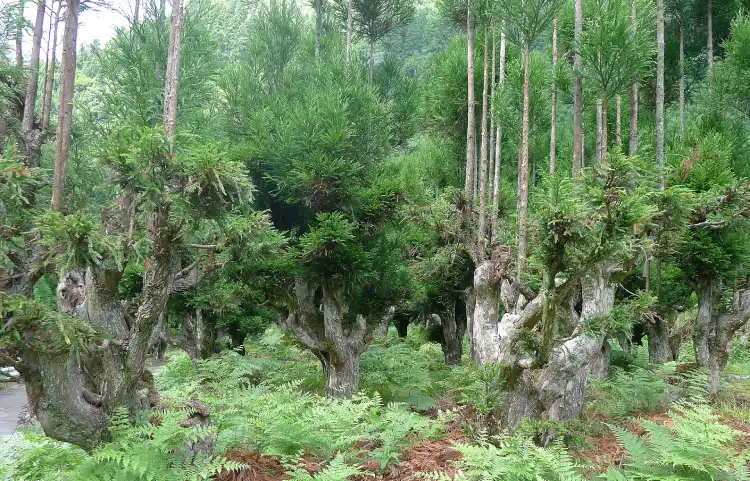
A 1974 paper by Japanese forester Ryookiti Toda describes the daisugi system in detail. The method keeps basal branches alive through heavy pruning.
When a Kitayama cedar is around five or six years old, several basal branches are retained while other growth is pruned. After the branches have developed for more than a decade, the main trunk is removed, and the remaining branches are trained to grow upward.
This produces the characteristic daisugi form – a large, established base from which several unusually straight stems rise vertically. The shape is the result of repeated pruning and careful management rather than a naturally occurring growth pattern.
When a suitable stem reaches the desired size, it can be cut, leaving the underlying stump and selected basal branches intact. New stems then develop from those retained branches.
The method therefore allows timber to be obtained through repeated management of the same underlying stump, rather than relying solely on planting a new tree after every harvest.
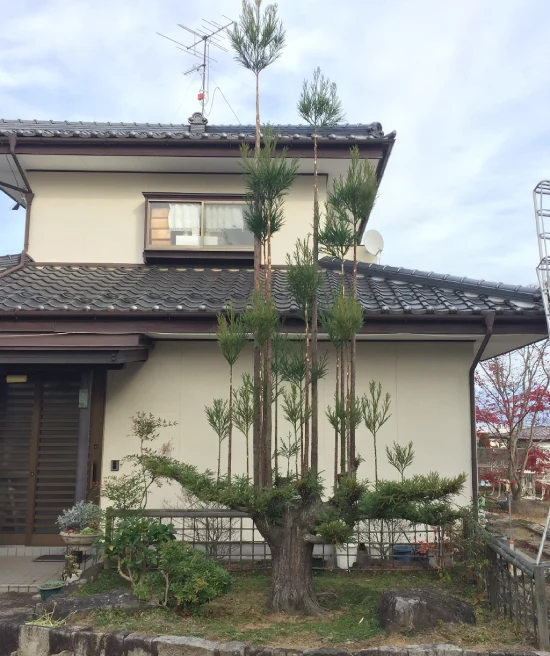
Daisugi is not currently the dominant commercial method of Kitayama cedar production.
Kitayama forestry itself has also faced major economic and labor changes. Declining timber demand, a shortage of forestry workers, and rising management costs have raised concerns about the future of the traditional Kitayama cedar forest landscape.
Nevertheless, daisugi remains part of Kyoto’s traditional forestry heritage. Kyoto City continues to document the technique, and its distinctive appearance has also made it popular as a tree for viewing and as an ornamental garden tree.
The technique is therefore best understood not as a modern replacement for conventional forestry, but as a specialized system developed through centuries of local knowledge.