Scientists Develop a 3D-Printed Diving Suit that Lets Cyborg Cockroaches Breathe Underwater
Scientists have created a tiny 3D-printed diving suit that allows remote-controlled cyborg cockroaches to survive and move underwater for up to three hours. The technology could help these insect-robot hybrids reach flooded or low-oxygen areas that are too small or dangerous for conventional robots, potentially improving search-and-rescue operations after disasters. The research was published in Nature Communications by scientists from Nanyang Technological University (NTU) Singapore and Waseda University.
The new suit helps overcome a major limitation of cyborg insects.
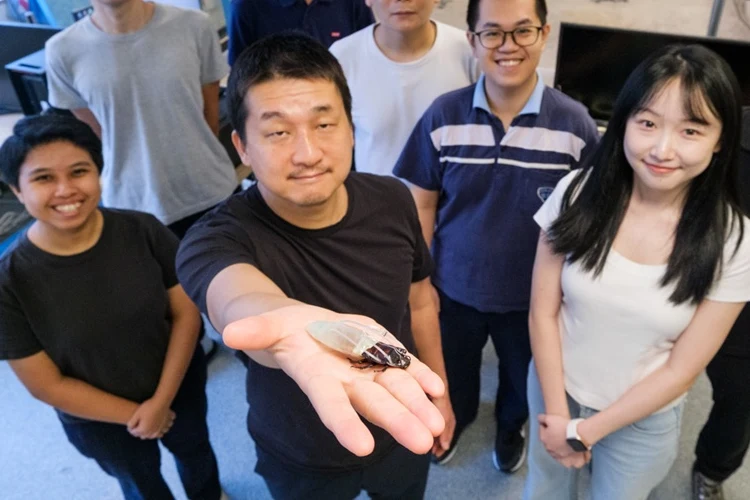
Cyborg insects are living insects equipped with small electronic controllers that can influence their movement. Unlike miniature robots, they rely on the insect’s own muscles for movement, which greatly reduces power requirements and eliminates the need for large batteries.
Until now, these insects could only operate on land because cockroaches breathe through tiny openings called spiracles that connect to their internal tracheal system. When submerged in water, they cannot absorb oxygen and quickly lose the ability to function.
The new wearable system solves this problem by supplying oxygen directly to the cockroach’s spiracles, allowing it to continue breathing even while underwater or in oxygen-poor environments.
The diving suit carries its own oxygen supply.
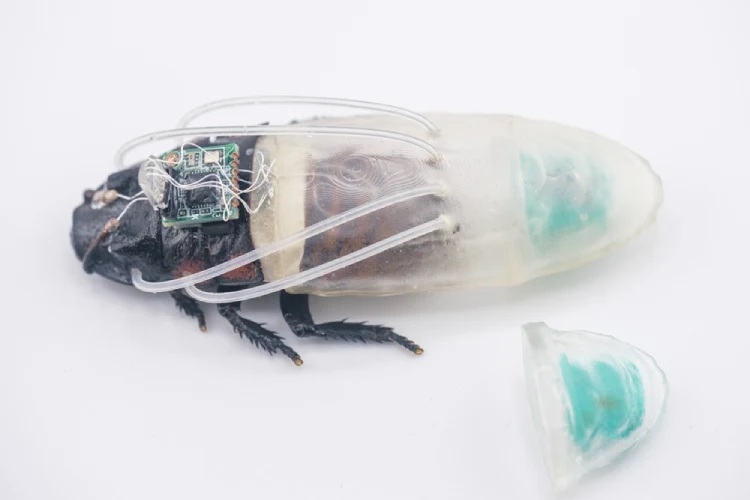
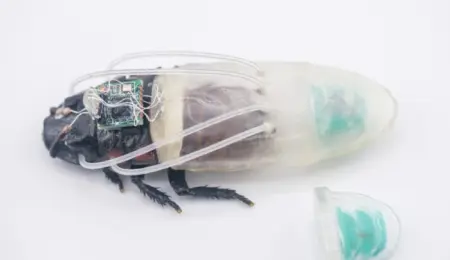
The underwater suit consists of three main components: a 3D-printed oxygen-generation tank, a flexible waterproof shell, and four silicone tubes that deliver oxygen directly to the cockroach’s spiracles, the tiny breathing openings along its body.
Together, these parts form a compact, self-contained system that keeps water out while supplying the insect with oxygen, allowing it to continue breathing and moving underwater.
The oxygen tank is printed from a transparent PMMA-based resin. Inside, researchers placed a sponge coated with manganese dioxide, which acts as a catalyst. Before use, they injected a small amount of diluted hydrogen peroxide into the tank and sealed it with ultraviolet adhesive to prevent leaks.
As the hydrogen peroxide slowly breaks down, it releases oxygen. That oxygen travels through the silicone tubes directly to the cockroach’s breathing openings while the waterproof shell prevents water from entering the respiratory system. The researchers said the tubes can be attached and removed without harming the insect.
The cockroaches stayed active underwater for up to three hours.
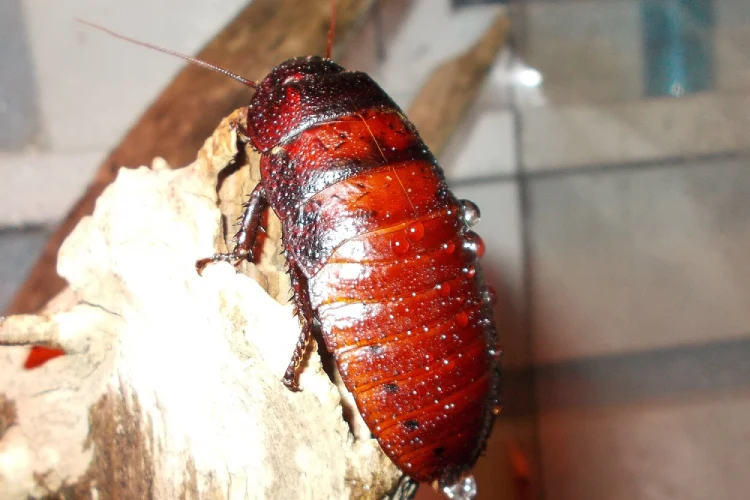
The team tested the system on Madagascar hissing cockroaches, a species commonly used in cyborg insect research because of its relatively large size, durability and wingless body.
To evaluate the suit, researchers created plastic-tube environments that simulated flooded tunnels and carbon dioxide-filled spaces to mimic low-oxygen conditions.
The cyborg cockroaches wearing the diving suit remained active and continued moving underwater for up to three hours. The system effectively transformed a land-based cyborg insect into one capable of operating across both land and water.
Researchers believe the insects could assist in disaster response.
The researchers say one of the biggest advantages of the technology is its potential use in search-and-rescue missions after floods, earthquakes and other disasters.
Flooded rubble, drains and narrow gaps are often difficult or impossible for conventional robots to enter. Small cyborg insects could navigate these confined spaces while carrying sensors that search for survivors or gather environmental information.
Professor Hirotaka Sato of NTU Singapore, who led the study, said the new system functions much like a scuba tank for human divers by supplying oxygen directly to the insect’s breathing system. He noted that extending the insects’ operating range to underwater environments could enhance their utility in rescue operations.
Professor Shinjiro Umezu of Waseda University said the main engineering challenge was designing a device that remained lightweight, flexible and compact while generating enough oxygen for extended underwater movement.
The technology could also inspect hard-to-reach infrastructure.
Beyond disaster response, the researchers believe the technology could be useful for inspecting flooded infrastructure, including drains, tunnels and pipes that are difficult for humans or conventional robots to access.
Future work will focus on improving the suit’s durability, testing it in more realistic disaster scenarios, and integrating navigation systems and sensors for practical field use.
According to the research team, the diving suit could eventually be adapted for other terrestrial cyborg insects, including different cockroach species, beetles, and locusts. These insects have similar respiratory systems that rely on spiracles connected to internal air tubes, making the approach potentially applicable to more than a single species.
The project builds on more than a decade of cyborg insect research at NTU Singapore. According to the researchers, earlier versions of these cyborg insects have already been deployed during real-world search-and-rescue efforts and are also being developed for infrastructure inspection. The team also stated that all insects used in the study were treated in accordance with research guidelines and were not harmed during the experiments.