What Did Children Play 450 Years Ago? One Painting Has the Answers.
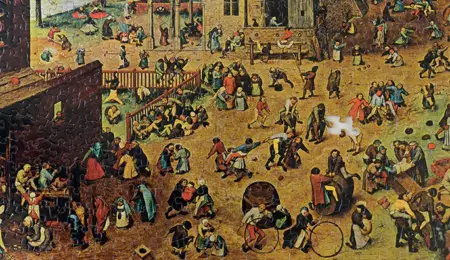
In 1560, Flemish painter Pieter Bruegel the Elder created a painting that offers an unusual glimpse into childhood nearly 500 years ago. Called Children’s Games, it shows more than 230 children playing 83 different games across a town square. Some are still familiar today, while others have largely disappeared.
The painting is packed with tiny scenes. Children climb, jump, spin objects, and pretend to be adults. At first glance, it looks like a busy playground, but on closer inspection it reveals an extraordinary record of how children entertained themselves in the 16th century.
Bruegel packed more than 230 children into one painting
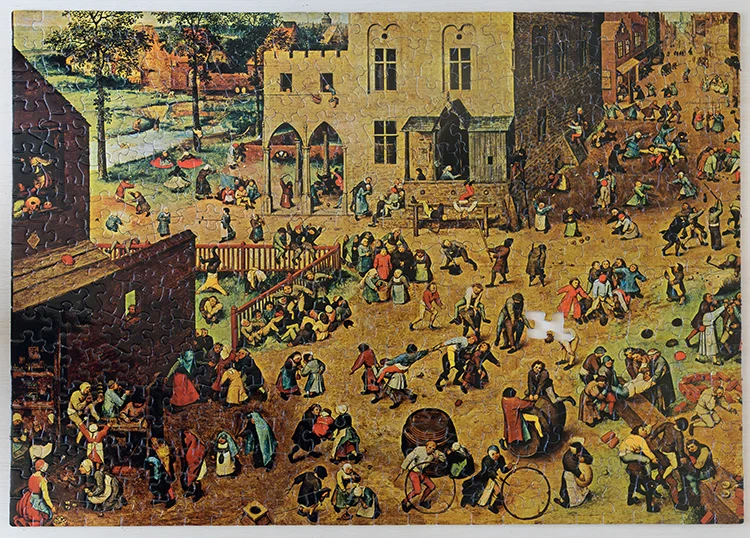
Children’s Games is an oil painting on a wooden panel, now housed at the Kunsthistorisches Museum in Vienna, Austria. Bruegel used a high viewpoint to fit an entire crowd into the scene, showing a large public square that stretches towards the surrounding streets and countryside.
Rather than focusing on one central activity, he filled the composition with dozens of small groups. Each group is doing something different, encouraging viewers to move their eyes around the painting and discover one activity after another.
The children are not arranged in neat rows or separated into organized play areas. They have taken over the streets, buildings and open spaces, turning the entire town into a playground.
The museum identifies 83 different games in the painting. Finding them all takes patience because some activities are easy to miss among the hundreds of tiny figures.
Many of the games would look familiar today.
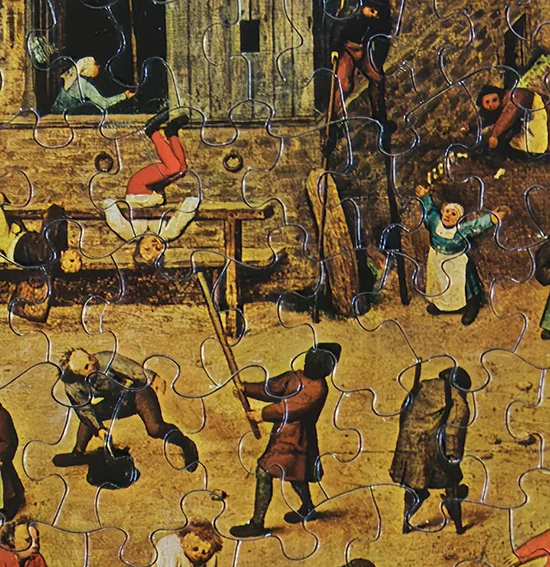
Some of Bruegel’s scenes show activities that children still enjoy. Blind man’s buff, for example, appears in the painting. In this game, one child is blindfolded and tries to catch the others using sound and touch.
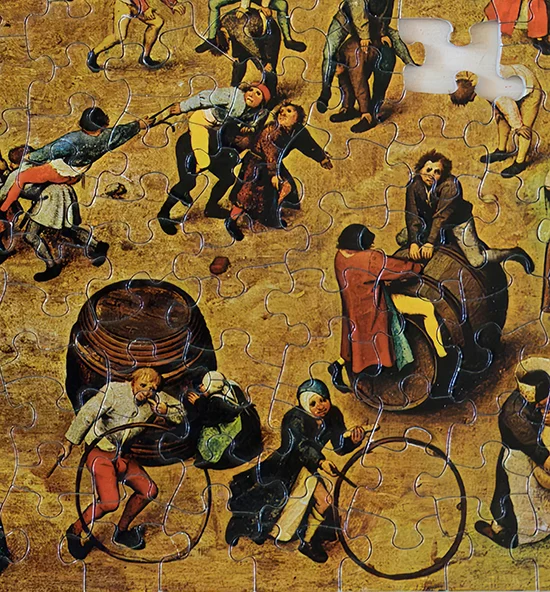
Other children play leapfrog, roll hoops, walk on stilts, and perform handstands. There are also spinning tops, hobby horses and children climbing trees.
Not every activity involves a specially made toy. Some children use ordinary objects such as hoops, barrels, pieces of wood and bones. These everyday materials became playthings through imagination and simple rules.
The painting also captures children copying adult behavior. Some are pretending to be shopkeepers, while others act out ceremonies such as weddings and christenings. These scenes suggest that play was not limited to physical games. Children also recreated the social activities they observed around them.
This is one of the painting’s most interesting aspects. It shows children finding entertainment in their surroundings rather than relying on a large collection of manufactured toys.
Historians still debate what Bruegel wanted to show.
Although the painting looks like a straightforward celebration of childhood, its meaning has been debated for centuries.
Some interpretations treat the games as a warning about human foolishness, suggesting that adults can behave as thoughtlessly as children. However, modern art historians have questioned whether this interpretation fits the painting’s original historical context.
Art historian Amy Orrock has examined the work alongside 16th-century educational writings and literature. Her research suggests that people also viewed games and play positively during this period, particularly in discussions about children’s education and development.
No definitive record explains why Bruegel created the painting or what message he intended to convey. Its original commission is also unknown.
What remains clear is that Children’s Games preserves an extraordinary range of everyday activities from 16th-century life. Nearly five centuries later, viewers can still recognize the excitement of children playing together, even when the rules of some games have been forgotten.